


Article: The Barbour Wax Jacket: From Working Garment to Cultural Icon

The Barbour Wax Jacket: From Working Garment to Cultural Icon
Barbour did not begin with the Bedale or the Beaufort. Nor did it begin as a country-fashion brand.
When John Barbour established his business in South Shields in 1894, his customers included sailors, fishermen and mariners working around the North East coast. Oilskins and other protective garments were equipment before they were style. The proposition was straightforward: clothing had to work in British weather. By 1917, Barbour’s mail-order catalogue was already sending garments as far afield as Chile, South Africa, Hong Kong and the Falkland Islands.
That functional beginning produced a surprisingly varied range long before the wax jackets now regarded as Barbour classics appeared.
Motorcycling became one important strand. Duncan Barbour introduced the International motorcycling suit in 1936 for the International Six Day Trials. During the Second World War, Barbour adapted that experience into the two-piece Ursula suit for submarine crews, after a request from Captain George Phillips of HMS Ursula. The suit subsequently became standard issue within the submarine service.
Country clothing developed alongside it. The Solway, introduced in 1960, was a substantial waxed jacket built for serious outdoor use. The Gamefair became another important long country style during the 1960s. Then came the Durham in 1969, cut from unusually light 4oz waxed Egyptian cotton for fishing, stalking, birdwatching and walking. Its cape shoulders, hood, generous pockets and drawcords were determined by weather and purpose rather than fashion.
Long before the 1980s, Barbour therefore understood how to alter cloth weight, length, pocketing and construction according to what a garment was actually expected to do. Heavy coats, lightweight shells, motorcycle suits, fishing clothes and shooting jackets already belonged to the same company.
This matters because it changes the usual story of the Barbour jacket.
Margaret Barbour joined the board after the sudden death of her husband John in 1968 and became Chairman in 1973. She inherited not a blank sheet of paper, but almost eighty years of accumulated knowledge about protective clothing. Her achievement was to take much of that knowledge and turn it into a clearer, lighter and more widely wearable family of garments.
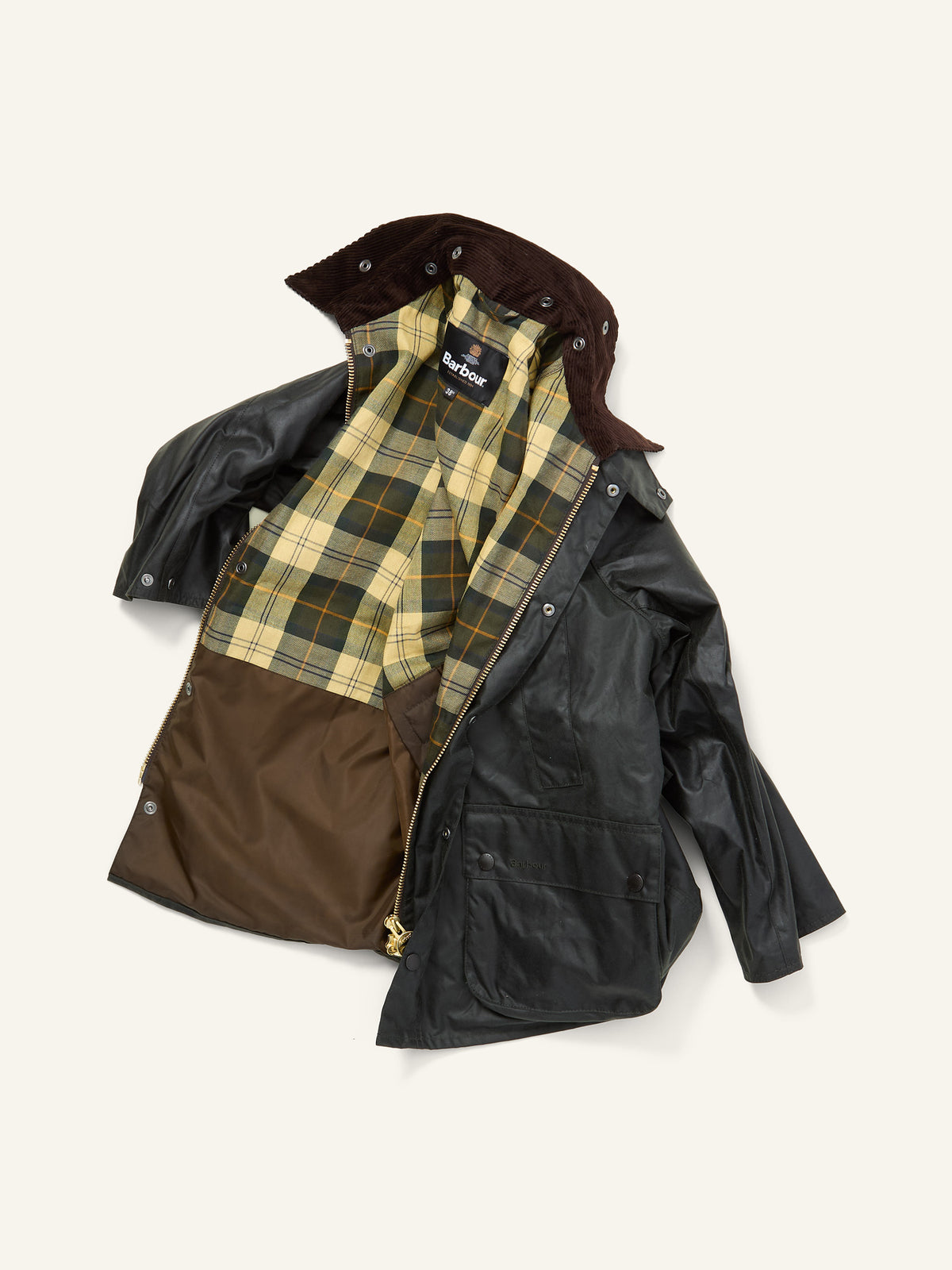
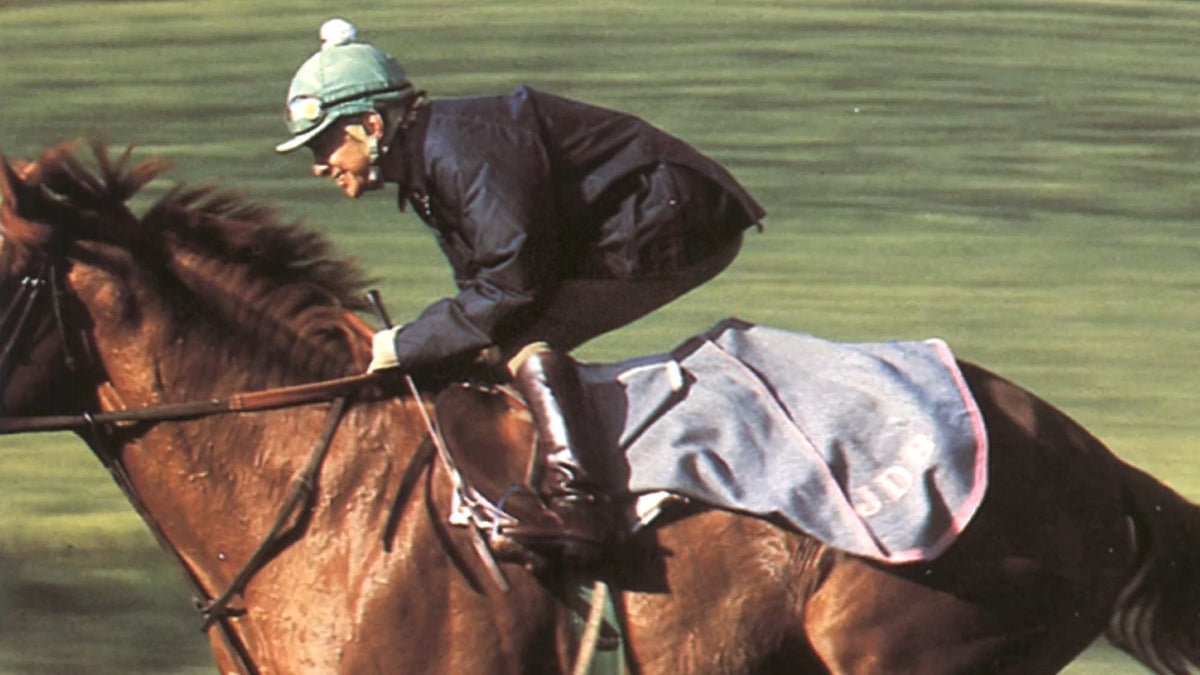
 The Bedale, introduced in 1980, was arguably the decisive step. Barbour describes it as a lightweight Thornproof short jacket designed specifically for equestrian use. Its compact length worked in the saddle, rear vents allowed movement, and the broad internal drip strip protected the lining from the damp realities of riding. It was recognisably Barbour, but much more jacket-like than the longer country coats that had preceded it.
A year later came the Spey, Barbour’s first jacket designed specifically for fly fishing. Its exceptionally short body was made to sit above waders and leave the wearer free to cast. It is a useful reminder that Margaret Barbour’s early period was not merely about making old country clothing smarter or more urban. Barbour was still creating highly specialised equipment around particular pursuits.
The longer Border continued another established strand of Barbour design: the generous country coat with enough coverage for layers and tailoring underneath. It belonged to the same early-1980s simplification of the range, but its basic proposition already had clear ancestors in garments such as the Gamefair.
Then, in 1983, came the Beaufort. It occupied a particularly useful middle ground. Longer than the Bedale but still unmistakably a jacket, it was roomy enough for layers and just long enough to cover a tailored jacket. Barbour often describes the Beaufort as inspired by French shooting jackets, but the basic archetype was already well established in its own countrywear range. The clearest French influence appears to be the full-width rear game pocket, externally accessible from both sides, rather than the overall form of the jacket. Earlier British shooting coats, including Barbour’s own, more commonly carried game internally. It is this rear pocket that remains the Beaufort’s most characteristic detail, and one that has proved almost as useful for newspapers, gloves and the ordinary cargo of daily life.
At the heavier end of the family sat the Northumbria. Its long body and heavyweight 8oz waxed cotton made it much more of a weather coat than a Bedale or Beaufort. Vintage A400 Northumbrias went further still: surviving examples used heavyweight Thornproof outer cloth together with a wool-mix Hunting MacKinnon tartan lining, giving them considerably more warmth than the cotton-lined jackets around them. The present Classic Northumbria retains the long cut and heavyweight 8oz outer, now in Sylkoil, but uses a pure cotton Barbour tartan lining.
Seen against the older Barbour archive, these early-1980s jackets look less like sudden inventions than an unusually successful distillation of things the company already knew. Raglan sleeves, corduroy collars, storm fronts, waxed cotton, game carrying and capacious pockets had all appeared before.
What changed was the clarity.
The garments became lighter where they could, shorter where the activity demanded it, and easier to understand as a family. Medium-weight 6oz Thornproof became particularly important. Its smoother, cleaner and slightly lustrous surface gave the new jackets a rather different appearance from some of Barbour’s heavier working coats. They remained functional country clothes, but they were increasingly easy to wear away from their original purpose.
The timing could hardly have been better.
Barbour received its first Royal Warrant from the Duke of Edinburgh in 1974, only a year after Margaret became Chairman. HM The Queen granted another in 1982, followed by the Prince of Wales in 1987. The chronology matters. Royal approval did not follow fashion. It came first, confirming Barbour’s position as a serious supplier of country and outdoor clothing before the jackets acquired a much wider cultural meaning.
There is also a particularly interesting Scandinavian footnote.
In 1976, Swedish agent Claes Asker was appointed to represent Barbour in Scandinavia. This was remarkably early: before the Bedale, before the Beaufort and before Barbour had become a household name even in Britain. Scandinavia was therefore looking at Barbour as serious functional British outerwear years before the international lifestyle brand took shape.
That early Scandinavian connection makes sense. A waxed coat designed around rain, wind, shooting, fishing and outdoor life did not require much cultural translation here. Barbour would later build a much broader international distribution network, but Scandinavia had already found the company while it was still, in essence, a specialist British country outfitter.
Back in Britain, the wider cultural change arrived with the Sloane Ranger.
The term was famously codified in The Official Sloane Ranger Handbook in 1982. The wardrobe it described drew heavily on country life: tweed, cords, riding clothes, Wellington boots and waxed jackets, carried into Chelsea and Sloane Square by people whose lives moved between London and the country.
This is where the Barbour jacket acquired a second meaning.
A Bedale or Beaufort still worked because of its original function. The pockets still carried things. The wax still kept out weather. The proportions still came from riding, shooting or layering. But those same characteristics now communicated something socially: horses, estates, dogs, weekends outside London and a particular kind of British continuity.
Barbour did not have to remove the function to become fashionable. The function was what gave the clothes authority.
That distinction helps explain why the jackets survived the Sloane Ranger moment rather than disappearing with it.
The old waxed cotton also helped. Barbour’s smoother Thornproof finish, particularly in Sage, produced the familiar slightly shiny green jacket associated with the 1980s town-and-country look. Sylkoil, by contrast, is softer and more matt, retaining more of the uneven character of the cotton and appearing more weathered from the beginning. Both mark, crease, dry and change through wear. Neither was ever intended to remain immaculate.
A worn Barbour records its use.
The wax can be renewed. Tears can be repaired. Linings and zips can be replaced. Barbour itself has been offering repairs and rewaxing for more than a century, with rewaxing and repairs appearing in its catalogue as early as 1921.
Margaret Barbour’s achievement was therefore much larger than designing a few famous jackets. She took a specialist family company with a deep archive of functional clothing and turned it into an international lifestyle brand without removing the working garments from its centre.
That transformation was gradual. The Royal Warrants supplied establishment authority. Bedale, Spey, Beaufort and the wider early-1980s range gave the company a clearer product language. The Sloane Ranger years carried that language into town. Later generations took it into music, streetwear, fashion and collaborations.
Yet underneath all of that remains the original logic.
The Bedale is short because a rider needed it to be. The Spey is shorter still because a fisherman stood in waders. The Beaufort carries a large rear pocket because it was intended for the field. The Northumbria is long and heavy because protection from bad weather sometimes matters more than convenience.
Fashion has rediscovered those shapes repeatedly because they were not arbitrary shapes in the first place.
The 1980s did not invent the Barbour jacket. What Margaret Barbour did was distil nearly a century of British functional design into garments that could travel far beyond their original use.
They have been travelling ever since.